
Today, consumer power has reached a critical threshold. For restaurant operators and food retailers, positioning themselves correctly in the Occasion Economy, where spending is driven by targeted emotional moments, is now make-or-break.
According to The Culinary Edge’s June 2026 Pulse Report, traffic has overtaken food and labor costs as the industry’s most contentious battleground. With restaurant guest counts tightening, diners are growing deliberate about when, where, and why they spend. Younger cohorts like Gen Z are spending more on food than ever before but they’ve changed what they prioritize, upending conventional dining routines. Traditional sit-down meals and rigid routines are increasingly replaced by deliberate "little treats," edible mini-escapes, and emotionally restorative dining rituals. Now, to win their business, winning brands must deliver optimal solutions for distinct micro-occasions rather than just basic fuel.
1. Eating Your Emotions: Deconstructing the Modern Need-State
Modern consumers use food to satisfy psychological needs alongside physical hunger, selecting dining options based on Need States or real-time emotional drivers ranging from mental fatigue to social validation.
In a demographic landscape where traditional adulthood milestones (such as homeownership) feel out of reach, food has transformed into an accessible luxury. Edible self-care is no longer the infrequent indulgence of a celebratory birthday dinner or break-up ice cream binge. It has become a recurring coping mechanism and a foundational part of daily mental health maintenance.
The New Consumer Rhythm
Morning Energy & Affirmation: Swapping plain commuter coffee for a 7 Brew Blondie or Panda Cold Brew topped with sweet cold foam turns a morning caffeine run into a customized daily reward.
Midday Break & Sensory Escapism: Upgrading a rushed desk lunch to a Sweetgreen Crispy Rice Bowl or Harvest Bowl transforms midday fuel into a vibrant, textured break from work monotony.
After-Work Wind-Down (Eataly): Grabbing fresh pasta from Eataly’s counter, like Spring Pea Ravioli paired with a bottle of Italian rosé, shifts weeknight dinner from a chore into effortless, at-home decompression.
Solo Dining & Intentional Solitude (Erewhon): Picking up an Erewhon Spicy Tuna Crispy Onion Roll or Sushi Box from the sushi bar turns eating alone into a curated, guilt-free "solo date."
Weekly Milestones (First Watch): Gathering over First Watch’s Million Dollar Bacon and seasonal brunch specialties transforms weekend mornings into a celebratory ritual to mark the end of the workweek.
2. The Structural Shift: Moving from Dayparts to Need States
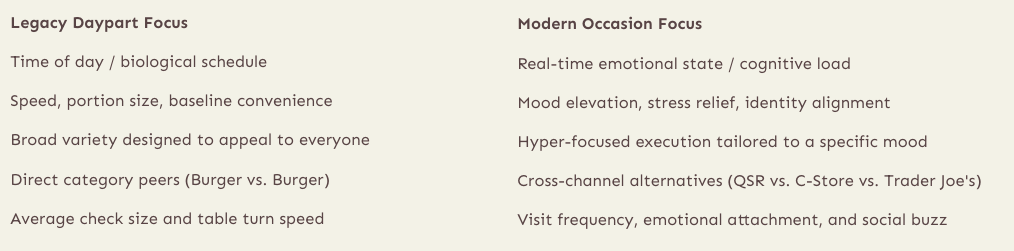
Historically, restaurant menu engineering and operational planning were anchored to fixed dayparts: Breakfast, Lunch, Dinner, and Late Night. Kitchen prep, staffing, and promotional calendars operated on the assumption that hunger occurred on a clock.
In the Occasion Economy, the clock has lost its authority. As modern diners are making purchasing decisions according to need states, traditionally bound drivers have been left behind:
3. Winning in the Niche: Archetypes of Emotional Precision
One size does not fit all. Generic, broad-appeal menu strategies are declining in effectiveness. While tight consumer budgets and operational convenience remain foundational baseline expectations, brands must demonstrate clear net value beyond these table-stakes features.
To capture market share, foodservice operators must focus on feelings. In a world where food is so much more than fuel, from an escape to a pick-me-up to a moment of connection, operators must appeal to our sensitive sides. Brands that succeed are driven by emotion and specificity. They aren’t trying to be everything to everyone, but the right choice for a specific feeling and moment in time.
A. Trader Joe’s: The Micro-Escapism & Novelty Discovery Occasion
On paper, for the task of grocery shopping, Trader Joe’s might seem to fall short. Limited choices and long lines wouldn’t be the older generation's first pick for the weekly chore of getting groceries. But Trader Joe’s does not position itself as a standard grocery shopping experience.
The Anti-Chore Model: While traditional supermarkets compete on massive footprints and endless generic choices, Trader Joe’s treats grocery shopping as recreational discovery and preserves the intimate neighborhood atmosphere.
Dopamine-Driven Drops: Seasonal product drops (from ube spreads to butternut squash mac and cheese), colorful packaging, and Hawaiian-shirt-clad "crew members" transform standard pantry restocking into a playful, discovery-driven self-care ritual.
B. Dutch Bros: The Emotional Affirmation & Custom Pick-Me-Up Occasion
Hospitality Over Speed: In an era where drive-thrus are optimized for robotic speed and minimal contact, Dutch Bros explicitly hired for "high-vibe" connection. "Broistas" engage customers with small talk and warmth, making the interaction feel like an emotional recharge rather than a mere caffeine transaction.
The Customizable Reward: With endless flavor combinations, energy drinks (Rebel’s), and photogenic layers, drinks are engineered as custom badges of personal identity. For Gen Z, buying a customized cup isn’t functional fuel, it’s an affordable mood booster.
C. Salt & Straw: The Cultural Storytelling & Flavor Event Occasion
The Monthly Ice Cream Drop: Taking a cue from streetwear culture rather than dairy scoop shops, Salt & Straw introduces curated flavor flights that rotate every single month.
Experiential Social Currency: Ice cream is rarely consumed purely for calorie intake; it is an inherently social milestone. By centering innovative flavors and storytelling into seasonal drops, Salt & Straw gives diners a distinct reason to visit this month and broadcast that visit on social feeds before the flavor window closes.
D. In-N-Out Burger: Tribal Belonging & The Insider Knowledge Occasion
Radical Menu Discipline: Rather than diluting operational efficiency with endless LTOs, chicken pivots, or plant-based experiments, In-N-Out maintains a small but mighty core menu of just burgers, fries, shakes, and sodas.
The Secret Menu as Social Capital: Unlisted configurations like "Animal Style," the "Flying Dutchman," or customized well-done fries never appear on the physical menu boards. Ordering them functions as an unwritten cultural handshake, transforming a routine fast-food visit into a club ritual that fuels viral "menu hack" sharing across social feeds.
4. The Operator’s Playbook: Engineering for Occasion-First Dining
Translating emotional drivers into sustained operational profitability requires more than adding trendy ingredients. Operators finding success in this new terrain are starting to paint a clearer picture on how to design functional pillars to align with modern needs:
Sensory & Textural Contrast: Visual appeal catches attention on social media and physical texture drives repeat visits. The explosion of cold foams, boba pearls, crunchy chili crisps, and layered beverages reflects consumer demand for tactile stimulation during otherwise monotonous daily routines.
Ritual Over Pure Transaction: Brands that command loyalty engineer memorable rituals into the guest interaction. Whether through unwritten menu codes at In-N-Out or the upbeat greeting at a Dutch Bros drive-thru, operational rituals turn transactional food runs into recurring habits.
Episodic Scarcity Over Stagnant Menus: Permanent menus breed customer procrastination and reduce urgency. By running structured, recurring drops like at Salt & Straw, operators create a compelling reason to visit now.
Radical Cognitive Relief: Faced with decision fatigue in their professional and personal lives, consumers often perceive extensive, 50-item menus as a burden. Focused concepts provide comfort by eliminating mental friction: customers know exactly what they will receive, executed with consistency every time.
Ultimately, the brands defining the future of foodservice won’t be the ones offering the most options, but those offering the clearest emotional payoff. There is no room for the "mushy middle", or concepts clinging to broad-appeal menus that fail to compete with the ruthless efficiency of pure value on one end, or the experiential pull of premium micro-indulgences on the other. In a split market where consumers will trade down for convenience or trade up for connection, survival and relevance belongs to the operators bold enough to take the leap and choose a side.
SOURCES
“Currents of change: Gen Z and Millennial occasion insights”, Hartman Group, June 2, 2026
“Gen Z Restaurant Spending is Growing, Not Shifting”, Revenue Management Solutions, August 2026
"TCE Pulse Report | June 2026 Edition: The Occasion Economy: How Consumers are Transforming Foodservice," The Culinary Edge, June 29, 2026.
